
Newsletter #33: Servant Leadership in the Age of AI
Oct 08, 2026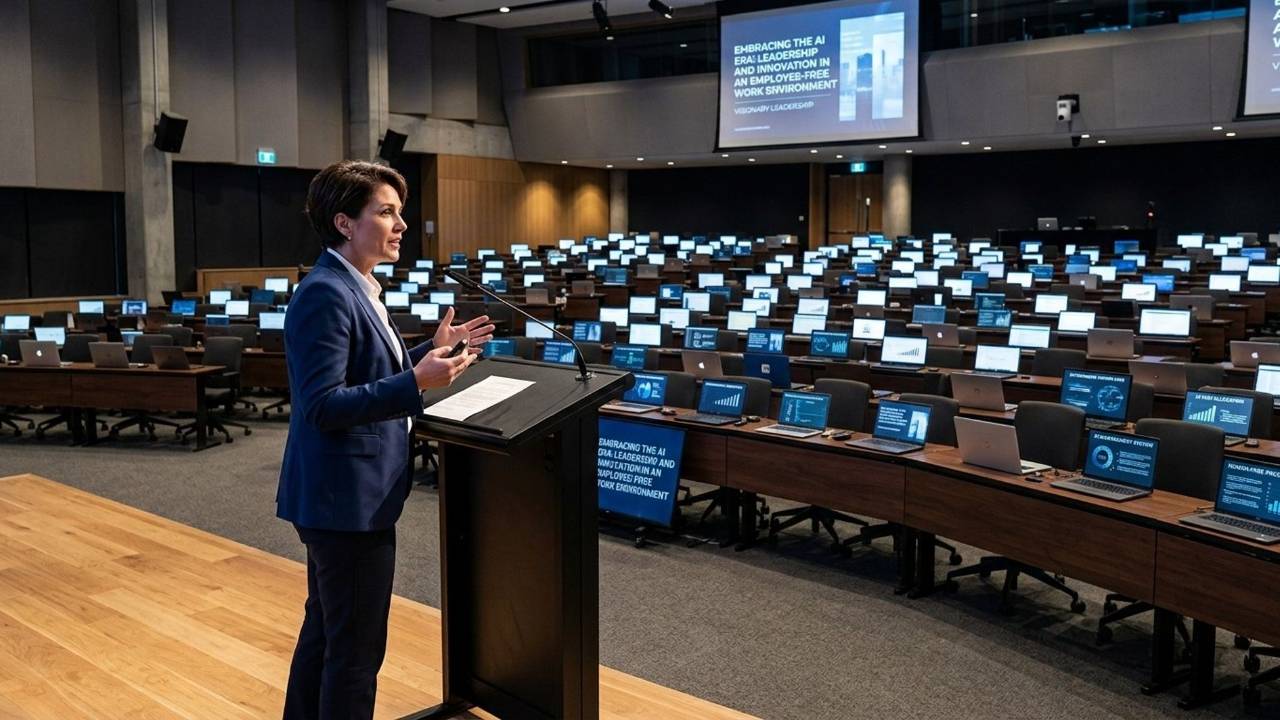
On December 2nd, 2003, my Kellogg MBA classmates and I braved a snowstorm to arrive at Northwestern’s campus in time for our evening Managerial Leadership class, unsure about what was about to transpire. According to our syllabus, our guest lecturer that evening was supposed to be Phil Condit, Chairman and CEO of Boeing – but he had voluntarily resigned from the company the day before amidst a government contracting ethics scandal involving two senior employees (Condit was himself absolved of any wrongdoing). As we took off our coats and were seated, our professor - Robert Neuschel - walked into the room and suggested we would need to pivot the class, since it was unlikely that Condit would show. So, he asked us to open “Servant Leadership,” the course book he had authored which was the academic foundation of his leadership philosophy and our course. Neuschel’s concept of Servant Leadership was built upon research showing corporations that focus on short-term economic value tend to deprioritize enduring cultural values and team development. On the other hand, organizations where leaders view themselves as servants to their teams tend to be better at driving long-term value creation.
Just as Professor Neuschel cracked open his book at the podium, the door opened and in walked Phil Condit.
Over the next 2 ½ hours, not only did Mr. Condit keep his commitment to our class to come speak, he regaled us with a vulnerable retrospective of his career. He spoke of his motivations, his learnings, his successes and his failures – including the one that led to his ouster from Boeing a day earlier.
Condit shared with us that the causes of great leadership include a lifelong passion for learning, an ability to listen, an ability to develop a vision (‘from learning, extrapolate: what will the world look like in 5 to 10 years?”), and the ability to communicate your vision with clarity (“the ability to communicate directly with a large number of people is part of the technological paradigm shift. The future won’t be hierarchical”).
Condit subscribed to several tenets throughout his career. One such tenet was a sense of humility and grit: “Do your present job better than anyone else. Be the best floor sweeper there is.” “You have to be willing to walk out the door at any point- because then you can make the best possible decision.” “Titles and degrees shouldn’t matter- if they put you on the street with $100, can you live? Is your self-worth due to you, or your titles?”
He compared being a leader to being an educator. He spoke about emotional intelligence as being hugely important to strong leadership. He spoke candidly about what happened under his watch which led to his resignation.
I had spent most of my childhood in Seattle, and since he had made the controversial decision to relocate Boeing’s headquarters from my hometown to Chicago years earlier, I asked if he felt in retrospect that it was the right decision. “That was one of the biggest decisions of my career. And yes, that decision was the right one. Given how our corporate strategies had shifted, we really could not be as effective so far from our suppliers and customers.”
Before I recently reviewed my notes from that class, I barely remembered the above quotations. But seared in my memory was my surprise at Mr. Condit keeping his commitment, and his candor in sharing the good, the bad, and the still-fresh ugliness from his career. In short, I remember being hugely impressed by his character.
Less than 25 years later, dynamics in the American business climate are dramatically shifting. Companies are becoming less labor-dependent over time as the cost of compute has fallen and automation of tasks has increased. This is increasingly true in the three years since AI burst into the collective consciousness with the launch of OpenAI’s ChatGPT in November 2022. According to a recent report by Liz Ann Sonders and Kevin Gordon at Charles Schwab, “hiring activity started to slow as the modern AI era kicked off…Companies are getting more output from slow-growing hours worked, and labor costs are rising more slowly than prices, which flatters profit margins.”
I have independently been tracking this trend for several years now, with similar findings. Two ways I have been looking at the phenomenon are as follows:
- Since 2000, labor productivity (defined as output per labor hour worked) has increased at a compounded 2% per year, which is about 10% higher than the 1980 to 2000 period (1.8% per year). Since the launch of ChatGPT, this metric is now compounding at 2.9% per year- a growth of 45% versus the 2000 to 2020 baseline.
- Comparing real employee wage rate growth versus corporate earnings growth. According to the Bureau of Labor Statistics, since 2000 the average number of employees per American company has dropped by 20% while real wages per employee have been flat. Meanwhile, real corporate earnings per American employee accelerated: from a compounded annual growth rate of 5.2% during the 2000 to 2020 period, to a 7.2% CAGR from 2023 to 2026. In short, more total companies, with fewer necessary workers per company, driving more profits.
According to Sonders and Gordon, “past technology waves eventually raised productivity and created new kinds of work, but the gains arrived unevenly and often with lags. Early on, the rewards tended to accrue for the companies building and selling the technology, while the broader labor market adjusted more slowly.” This seems to be an understatement of the impact to the labor market due to Artificial Intelligence over the past several years: in 2026 alone, companies have laid off tens of thousands of employees, attributing the cuts to Artificial Intelligence. “The layoffs were at least partly due to…needing to become AI native” (Coinbase CEO Brian Armstrong); “AI had made the roles obsolete…[The shift is] a move toward an agentic AI era” (Cloudflare CEO Matthew Prince); “we questioned how many humans would need to stay if the company was built with the latest AI tools” (Block CEO Jack Dorsey); “[The cuts are attributed to] the tech sector’s AI overhaul” (Microsoft Chief People Officer Amy Coleman); and many others.
If we are moving towards a sustained future state with fewer employees per company and greater profits per employee, it begs the question:
“Will servant leadership – or leadership at all - even matter anymore?”
According to Newcomer, the answer is a resounding “yes”- and not only to motivate the employees that remain, but moreover to direct the conscience of a business and its industry. In the Newcomer article “There’s a Leadership Vacuum in Silicon Valley,” the authors write that this is particularly true in Tech, where the “industry needs a stateman.” With the departure of Apple CEO Tim Cook, what remains is a Tech industry that “lacks leaders who command broad respect across the industry, just at the moment when it needs them most. There is no Jamie Dimon in Silicon Valley, no Bob Iger, no Warren Buffett — businesspeople who know how to make money but also have a broad lens and an interest in what their decisions mean for the world.” And the Tech industry’s influence will only continue to grow. According to Andreessen Horowitz, Tech has become “the Everything Cycle” (given that tech accounts now for 55% of capital spending and nearly 50% of profits of the S&P 500) “and it’s not looking back.”
The Technology industry has seen a direct hit to payrolls, now at their lowest levels since 2015- but it isn’t the only industry grappling with the role of labor and leadership in an AI-centric business world. The “financial industry’s payrolls have struggled….the decline in net hiring has turned more aggressive, matching the trend seen in the Information industry” (Sonders and Gordon). Within the retail and consumer packaged goods industries, where Ocampo Capital operates, the labor impact is seen thus far in a dramatic shift in how people do their jobs, and from “gut instinct” to “data stewardship” in how leaders make decisions (according to Deloitte, EY and Consumer Goods Technology). Broadly across industries, the 2026 Businessolver State of Workplace Empathy AI Special Report reported that 30% of C-suite executives now believe that “organizational empathy ‘gets in the way’ of” business goals. Furthermore, those that are prioritizing AI-driven headcount reduction are “more likely to see empathy as an obstacle”- completely counter to Professor Neuschel’s Servant Leadership philosophy.
Author and AI thought leader Pascal Bornet asks “are we ready to lead machines, not just people?” He argues that while human leadership remains important, there needs to be a new function of Human – Agent Orchestrator because “you cannot motivate an agent. You cannot inspire it with a better vision, and you cannot assume that because it performed well yesterday, it understands the unwritten judgment behind what you want tomorrow.” In a world where hybrid teams are increasingly made up of humans and agents, leadership must be more explicit and “hybrid teams introduce a second form of leadership that operates by very different rules.”
The World Economic Forum, in their Future of Jobs series, recently echoed Phil Condit’s comments from 2003 despite the different business climate today. They posited that across industries, leadership is morphing from a Command-and-Control style to a more flexible, “high-AQ (Adaptability Quotient)” style. This is marked by human-centered empathy, curious and imaginative leadership stances, and adaptive and resilient responses to the change around us. Likewise, it is requiring more of an exploratory skillset rather than a managerial skillset.
I strongly believe that the need for leadership isn’t going away. Servant Leadership in particular remains as relevant as ever, and perhaps even more so than in the past. Leadership now requires even clearer and more coherent communication skills- sometimes motivational, and sometimes expressly directive. It requires more humility, particularly in the face of opaque (and yet more democratized) information. It continues to require strong character and judgment. It requires constant learning, and an ability to see through the filter of hierarchy. It has always required knowing where your Circle of Competency ends (according to Charlie Munger, “It’s not a competency if you don’t know the edge of it. You are a disaster if you don’t know the edge of your competency”). Yet it is less reliant on lifting and landing prior experiences directly onto new problems. Instead, it requires contextualizing, and innovative thought, in tackling ambiguous situations. As Phil Condit and the World Economic Forum independently mentioned, it requires more adaptability than ever. And undoubtedly, these same skills and behaviors will become more prioritized in the hiring decisions of companies, since they will be needed whether businesses are massive (like two of my former employers, J.P. Morgan and Target) or small startups (like the businesses Ocampo Capital invests in and supports today).
Professor Neuschel, our professor for that memorable Managerial Leadership class, died of cancer two months after that snowy night with Phil Condit in 2003. But his concept of Servant Leadership lives on – and talented, high-character servant leaders will be even more relevant as we collectively push into an increasingly dynamic and opaque future.
Ocampo Capital is a trajectory amplifier: It advises, supports, and invests in consumer companies, aiming to help them achieve their aspirations.
We hate SPAM. We will never sell your information, for any reason.
