
Newsletter #28: Patrons of Progress? Fueling The Renaissance and the Information Age
May 19, 2026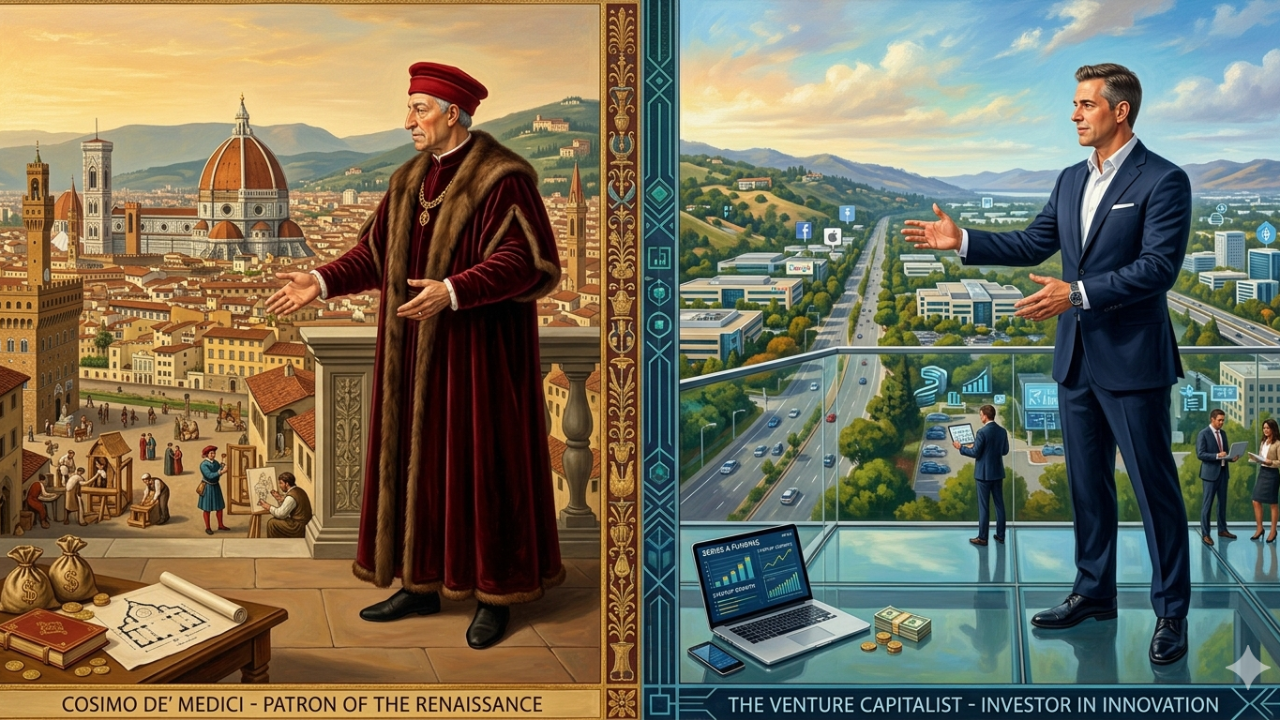
Alone in the dim Basilica of Santa Croce that morning in Florence, I was overwhelmed by its historical significance as the heart of the Renaissance. Standing in silence for what felt like an hour, I studied the detail of the tombs which hold the remains of some of the most important people in the history of the world: Michelangelo, Machiavelli, Dante, Galileo. I imagined the buzz of creativity five centuries earlier, in the piazzas and homes surrounding this specific church, in this Tuscan town of 50,000 on the Arno River. I thought about the Medici banking family that both founded the Platonic Academy in Florence in 1462, and were patrons to dozens of artists, writers and other incredible, wide-ranging thinkers. In Frans Johansson’s best-selling book The Medici Effect, he posits that the Medicis’ initial investment in Brunelleschi and Donatello - and then Leonardo da Vinci, Michelangelo, Botticelli, Raphael, Amerigo Vespucci and others – brought them all into close contact. And precisely at that intersection of different fields and cultures, choreographed by the Medicis, sprung the Renaissance.
As I exited the Basilica, into the brightness of the adjacent grass courtyard that early spring morning two months ago, I wondered: will future generations consider Silicon Valley the center of the Information Age, as we do now about Florence as the center of the Renaissance? Will the venture capitalists on Sand Hill Road be regarded as the Medicis of their day, in funding the Information Revolution?
These questions led me down a fascinating path of research, causing me to rethink some of my awe for the Renaissance origin story. I also reconsidered the commonly told history of Silicon Valley, and how the two locations compared in spurring on world-changing innovation.
Almost immediately, I found that I was nowhere near the first person to compare Silicon Valley to Florence. Several articles in recent years (especially in the years 2015 and 2016, for some reason) made that exact comparison. For instance, an article in the Harvard Business Review January 2016 publication, entitled “Renaissance Florence Was a Better Model for Innovation than Silicon Valley Is,” described the similarities between the Medici’s patronage and venture capitalists’ funding of startups today. But it also highlighted three major differences making modern VC worse than the Medicis’ model: 1. Mentors Matter (appreciated in the apprenticeship model of Florence, but not in the youth-driven culture of today); 2. Talent Needs Patronage (“today, cities, organizations, and wealthy individuals need to take a similar approach, sponsoring fresh talent...as a discerning investment in the common good”); and 3. Potential Trumps Experience (“we typically hire and assign important tasks only to those people and companies who have previously performed similar jobs in the past”).
Second, I learned that my assumption that the Renaissance occurred in a “Big Bang” choreographed by the Medicis was a massive oversimplification. In fact, many foundational elements pre-dated the Renaissance by hundreds of years:
- Florence had unique geographical advantages (the navigable Arno River, proximity to the mining of specific inputs, etc.) which allowed it to emerge as a textile hub during the Middle Ages;
- In the late Middle Ages, traveling merchant entrepreneurs caused an eruption of commercial activity between the Tuscan towns of Lucca, Siena and Pisa – and the relative latecomer Florence two hundred years later. While Florence was slower to emerge and land-locked, its natural advantages allowed it to eventually race past those other locales in economic and cultural importance.
- The surge of textile manufacturing, and the relatively expensive cost of merchant travel between towns, encouraged early banking families in the 1100s to finance those activities: the Peruzzi, the Bardis, and others. At this time, the Medicis were still focused on medicine (hence their name) and would not emerge as the legendary banking family of the Pope, Florentine commerce and the Renaissance until the early 1300s.
- This growth of commerce and banking in Florence attracted thousands of people from the Tuscan hillsides: the village exploded in size from perhaps 10,000 in the year 1000, to 30,000 by 1200, to a city of potentially 120,000 by 1300 just prior to the outbreak of the Bubonic Plague. This population growth forced Florence to twice relocate the city’s protective surrounding walls: first doubling its land mass in the 1170s, and then quadrupling further the geography inside the walled city by 1330. And along with that population expansion and increased sophistication inside those walls, came improved education and higher literacy rates than elsewhere.
- Dante Alighieri wrote the poem “The Divine Comedy” in 1320, a ‘theory of everything’ that reconciled human urges with spiritual devotion. Written in the Tuscan dialect, it established modern Italian as the national language. Ten years later, Petrarch (recognized as the father of humanism), pieced together Livy’s monumental “History of Rome” and found Roman masterpieces by Cicero, Propertius and others.
- Along with mercantile expansion, political and ecclesiastical expansion and exertion of power led to violence. From as early as the 900s, feudal rulers of Germany and elsewhere periodically invaded Italy. In the 1070s, the Pope began exerting authority over the European Church with the Dictatus Papae, then the Concert of Worms in the 1120s. The first Crusade, in the 1090s, led to further Crusades in the 1140s, and 1180 – 1200.
- The high cost of these military excursions forced kings and the papacy to engage the Florentine banking families to help finance them, further establishing Florence as the financial capital of Italy by the mid-1200s and the leading banking families as the power center of the city.
By the mid-1200s, the Republic of Florence was an established economic and political power - before the Renaissance began. Two more ingredients necessarily predated the founding of the Renaissance, but logically followed this late Middle Ages expansion of commercial trade and political clashes. First, the increased literacy in Florence, commercial exploration outside of Florence, and observations from soldiers participating in the Crusades expanded the worldview of the Florentine citizenry. This culminated in the discovery of important Roman and Greek writings from antiquity in monasteries and elsewhere: along with Petrarch’s discoveries, Poggio Bracciolini discovered Lucretius’ “On The Nature of Things,” Vitruvius’ “On Architecture,” lost orations by Cicero and Quintillian’s “The Institutes of Oratory.”
The final ingredient predating the Renaissance was the Bubonic Plague. This bacterium was carried by fleas, transported by mice along the merchant trade routes in and out of the cities. In Florence, the ‘Black Death’ breached its walls in 1347, killing more than half of its citizenry before the end of 1348. Those that survived the Bubonic Plague began reconsidering everything: they repudiated a world filled with crippling violence and crushing pandemics, grew nostalgic for the once-great Roman Empire and became fascinated by its humanist (albeit pagan) achievements.
This 300+ year, multi-faceted enriching of the soil in Florence uniquely caused the Renaissance to flourish there. But even then, the Renaissance did not happen all at once. By the 1350s, the Medicis had eclipsed the other banking families in Italy due to their lucrative financing of the papacy, thereby becoming the most powerful family in Florence. While Cosimo de Medici, the primary architect of the Medici dynasty, was purposely understated in his personal comportment, he rightly believed that the Republic of Florence was positioned to become the new center of culture and learning. Richard Goldthwaite in The Economy of Renaissance Florence described Cosimo and his descendants as “great international financiers as princes in disguise and art patrons,” but this patronage did not happen all at once. While I assumed that Brunelleschi and Donatello rubbed elbows with Michelangelo, Leonardo da Vinci and Raphael in the Medici Palace, in fact Brunelleschi and Donatello died before the three were born. In exploration, Amerigo Verspucci died 40 years before Galileo Galilei’s birth. And while the Medicis were systematic with their patronage, including providing “a far wider education than would otherwise have been available to” their chosen subjects over a 200-year period from 1350 to 1540, they never directly tied it to their own financial gain. Instead, they believed by forwarding humanist thinking they would further reinforce their soft power and influence with three main constituents: the Roman Catholic Church, the Signoria of Florence, and the populace. Eventually, this fixation on influence disrupted the Medicis’ banking empire: on one hand, it led to two Medicis becoming Pope. On the other, its extremely high cost led to the eventual financial downfall of the Medicis. Meanwhile, the Renaissance ethos had spread well beyond Florence by the 1500s, changing the world.
Silicon Valley, by contrast, emerged out of a combination of several factors over a much shorter time period: 1. San Francisco was founded on the gold rush of the late 1840s, with dreams of getting rich and a high tolerance for boom-and-bust cycles; 2. One hundred years later, the major emphasis on advanced scientific and mathematical study at Berkeley and Stanford, particularly during World War II and the first years of the Cold War, led to significant federal government initiatives to spur innovation without expecting direct financial payback; and 3. An irreverent, counter-culture movement in San Francisco, which always existed but strengthened during the 1960s, defied the existing establishment and emphasized originality in music, art, and other interests down the San Francisco peninsula. According to University of Washington historian Margaret O’Mara (author of The Code: Silicon Valley and the Remaking of America) the U.S. government contributed massively to the creation of Silicon Valley. “It played a huge role. But it wasn’t breathing down the necks of entrepreneurs. It wasn’t trying to take a cut. This gave room for enterprise and market competition to flourish.” In fact, early Silicon Valley powerhouses Varian Associates (1948), Fairchild Semiconductor (1957), SRI International, over 60 microchip companies, and ARPANET were built upon massive government contracts.
Contrasting the early government support of Silicon Valley, early individual venture capitalists in Silicon Valley were motivated almost exclusively by asymmetric financial returns. According to Sebastion Mallaby in The Power Law: Venture Capital and the Making of the New Future, “the Valley’s distinguishing genius is that the patina of the counterculture combines with a frank lust for riches…shattering traditional assumptions about hierarchy and authority and working loyally for decades until you retired with a gold watch.” While the Renaissance was somewhat of a pivot in thinking away from a Church-centered worldview - but where concepts of soft power, influence, and patronage were major motivators - none of those themes influenced venture capitalists in the early days of Silicon Valley. Instead, it was the venture capital financial imperative which countered the Federal government’s prior role in development of innovation. Despite the crucial role that government played in its early development, “a lot of Silicon Valley people felt the government was the problem, not the solution, and the best they could do was keep it as far away as possible from their business” according to O’Mara. In the mind of Don Valentine, legendary early venture capitalist and founder of Sequoia Capital, “the one thing worse than entanglement with government was entanglement with lawyers,” but “he felt free to back wild people if they were onto something lucrative.”
Of course, this has changed a bit over the past decade, as venture capitalists and tech company founders have become more interested in garnering political favor and increasing their soft power over federal and state government. And just as the Renaissance eventually spread beyond the walls of Florence to all of Europe, venture capital spread in recent decades far beyond Silicon Valley. According to the Forbes Business Council prognostications last August, “while traditional hubs like Silicon Valley will remain important, they won’t dominate the landscape. Instead, they’ll become part of a global network of specialized innovation centers.”
The Renaissance did not spontaneously occur in Florence. And contrary to my thinking, the Medicis were not necessarily the engine that drove the Renaissance: that engine was built by many people, over centuries. Instead, one could describe the Medicis as the gas that fueled the engine, once it was built and ready to run. Similarly, early venture capitalists in Silicon Valley were gas to fuel the growth of ideas and startups once most of the components that defined Silicon Valley were largely in place. The major difference is the expectation of where that fueled engine would take you.
I believe that modern venture capitalists will be compared to the Medicis for contributing to a revolution in societal thinking and human progress. The authenticity of early venture capital’s motive to drive asymmetric returns for portfolio companies was a clear and admirable purpose; but I agree with the HBR article that modern venture capital would be better if it more broadly embraced the Renaissance beliefs of mentorship, patronage, and identification of potential. And while we don’t know how this epoch will end, the recent pivot by Silicon Valley towards a greater influence over US government policy (including foreign policy) echoes the Medicis’ pivot to control of the papacy – an emphasis on soft power which ultimately distracted from its historical legacy.
Ocampo Capital is a trajectory amplifier: It advises, supports, and invests in consumer companies, aiming to help them achieve their aspirations.
We hate SPAM. We will never sell your information, for any reason.
