
Newsletter #26: "Boomcessions" and BS
Mar 26, 2026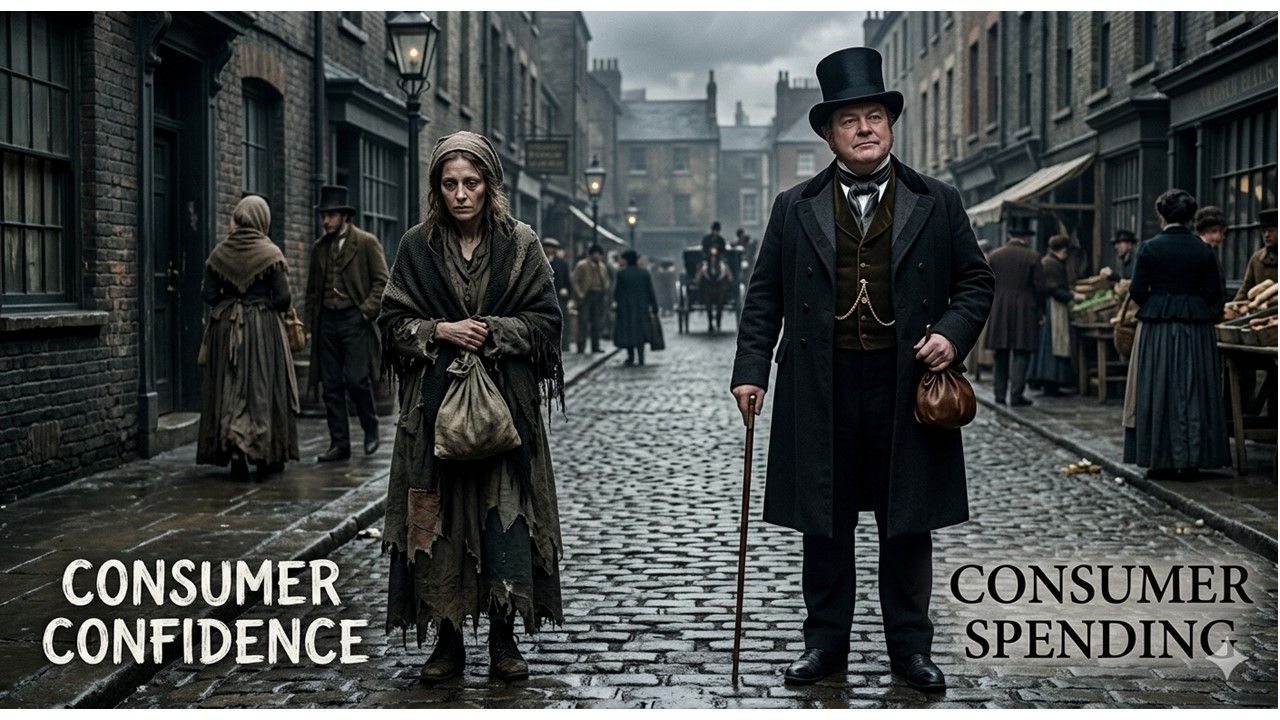
Famed author Nassim Nicholas Taleb once wrote, “in a complex world, intelligence consists in ignoring things that are irrelevant.” In recent months, I have been reminded of this quote several times while reading the news headlines surrounding the strength of the consumer.
Many news headlines purporting to assess the health of the consumer are irrelevant
Recent, provocative-sounding news blurbs have included “American Consumers are Miserable. But They Keep Spending” (The Economist, November 27th, 2025); and “Welcome to the ‘boomcession’…it’s thematically similar to the ‘vibecession,’ a term popularized in 2022 to explaining the disconnect between solid economic data and negative consumer sentiment readings” (CNBC, February 18th 2026).
Most of these articles concoct confused rationales for consumer spending because they rely upon the consistently negative monthly Conference Board CCI and U of Michigan Consumer Sentiment indices as major sources. In many of these articles, they assume the monthly consumer confidence readings are factually accurate representations of how the consumer is behaving.
There are three main reasons why these sentiment indices are not very useful for understanding the strength of the consumer overall:
- The surveys attempt to understand consumer optimism - not actual consumer spend – and those are not the same things.
- The methodology employed by these indices is faulty because of how they ask their questions to respondents. As any market researcher would tell you, there are always risks of significant biases with surveys, as well as skews in results based on how the questions are asked (in general, the Conference Board considers labor markets and business conditions more heavily, whereas the U of Michigan survey considers perceptions of inflation and purchasing power more heavily). And in the case of the U of Michigan survey, the survey sample size is too small to be representative of the entire US population of consumers.
- Because of points one and two above, consumer sentiment indices are historically about as correlated with consumer spending as a coin flip:
- The R-squared correlation of year-over-year retail sales data versus Conference Board CCI readings over the past ten years is 0.036.
- The R-squared correlation of year-over-year retail sales results versus the U of Michigan Consumer Sentiment Index readings over the past ten years is slightly worse, at 0.008.
Anyone who has ever read customer survey responses at a major retailer will confirm that when a shopper is asked if prices are too high, they nearly always say “yes” regardless of price - yet it doesn’t necessarily dissuade them from shopping at that retailer. Similarly, the Conference Board and U of Michigan consumer confidence surveys are not actually reflective of consumer spending – so when actual spending is healthy but consumer confidence appears weak, some uninformed journalists respond by making spurious and bizarre causal inferences.
Retailer quarterly earnings call commentaries are oftentimes also irrelevant
It is difficult to deduce anything meaningful regarding the strength of the consumer from leading retailer quarterly earnings call commentaries, despite the broad reporting of statements made on those calls. Oftentimes, attribution of retailers’ sales results to subjective statements about their customers says less about the consumer, and more about the retailer’s own strengths or deficiencies.
There is a distinct “center of gravity” on words used in retailer earnings calls over time, which indicates that they follow each other with the language they use in describing customer behavior. Assessing earnings call transcripts over the past 20 years from major retailers, patterns in word usage emerge. For instance, in 2007 – 2009 “underwater” and “deleveraging” were parroted across retailer earnings calls. From 2010 – 2015 those terms were replaced by “frugality” and “value-conscious;” then from 2016 – 2021 “promotional” and “headwinds” became popular; followed by the 2023 – present words “strained” and “pressured.” Usage of these subjective (and crowdsourced) terms as a barometer for actual spending is convoluted, particularly in reference to the broad consumer economy.
Quotes coming out of national consumer conferences are oftentimes also irrelevant
Last month, the Anaheim Convention Center hosted ExpoWest. Experts there described a “disciplined consumer” who is “currently value-conscious, selectively trading up, demanding functional benefits, and is less tolerant for hype and fads.” When comparing those descriptors to ones used in each year over the past decade in ExpoWest conference recaps, there is remarkable overlap and consistency. Moreover, those descriptors are relatively uninformative: when is a consumer not somewhat value-conscious? When are consumers not selectively trading up? When is a consumer not demanding some sort of functional benefit when they are buying products?
Likewise, the National Retail Federation’s 2026 conference take-aways of “cautious optimism,” “continued spending growth,” and “solid fundamentals” could describe 90% of the past 30 years. They also highlighted “a continued, historical disconnection between consumer sentiment (which has been downbeat) and actual spending behavior.” Exactly. See above for my commentary on both consumer confidence readings and the ExpoWest commentary.
Attempting to accurately assess consumer strength
Not to defend the vague and largely irrelevant commentary in the news, earnings calls and conferences mentioned above, but it is extremely difficult to describe the American consumer using thematic generalizations that update or change on a quarterly or annual basis. Most of the time, except for during extreme negative shocks (wars, oil shocks, pandemics, depressions) or during the very rare and short-lived periods of spending euphoria (the Roaring 20s, for example), or with the advent of revolutionary new technologies such as eCommerce, the consumer does not move in a coordinated and quickly-changing manner that is easily characterizable. Unfortunately, “consumer behavior changes are subtle and complex” is not a very buzzworthy headline.
Further to that point, and in an attempt to see around the distracting media reports and vague comments on the strength of the consumer, last month we surveyed our portfolio companies on the state of the consumer. Utilizing a scale of 1-10 (1 = “terrible” and 10 = “wonderful) we asked a series of questions. They ranked the strength of the consumer in 2024 as 7, and 2025 and 2026 as 6.5. For more premium and discretionary items, “we have not experienced any slowdown in velocities due to consumer spending. I firmly believe our customer is not being impacted by economic conditions…if anything, they are almost less price conscious and willing to pay a slight premium for convenience (Amazon).” On the other hand, among more price-conscious customers and in less premium categories, we learned “customers on the whole are trending towards higher total basket sensitivity and an increase in discernment pertaining to new product trial.”
These portfolio companies also ranked the overall economy in 2024 as a 6, 2025 as a 5.75, and 2026 as a 6. Comments included “from everything I’ve read, I thought the economy was going to start tanking in 2023. Every year it’s almost the same theme – economic pressures will massively impact consumer spending. And every year I haven’t seen an impact on our business.” Another founder stated “we’ve seen consumer sensitivity in real time over the past year. Since our brand is focused towards the top third and middle America, I think our exposure is limited but not zero.” By comparison, these respondents ranked the strength their own business momentum headed into 2026 as an 8.
These responses strike me as very plausible, rather unchanging from year to year in an absolute sense, and perhaps more legitimate than “vibecession” clickbait.
It will be interesting to see if the current Iran conflict – and its impact on gas prices – will change those baseline assumptions for 2026. Based on history, those shocks do tend to negatively impact consumer spending, particularly amongst more mature shoppers and in the short to medium term (but not immediately). But up until now, the data does not seem to conform to the constantly dour consumer confidence readings.
In summary, it would be a mistake to cloud investment decision-making in the consumer space based on fears of reported “boomcessions” based on consumer confidence readings. Likewise, the invention of terms such as “bomb cyclones” by meteorologists did not portend the apocalypse. Again quoting Nassim Taleb, “it takes a lot of intellect and confidence to accept that what makes sense doesn’t really make sense.”
Ocampo Capital is a trajectory amplifier: It advises, supports, and invests in consumer companies, aiming to help them achieve their aspirations.
We hate SPAM. We will never sell your information, for any reason.
